Have you been struggling with complicated RF metrics? Today, SFDR is explained once and for all, alongside its related metrics. To understand these three key indicators, we first need to get two terms straight: noise and distortion.
Noise vs. Distortion: What’s the Difference?
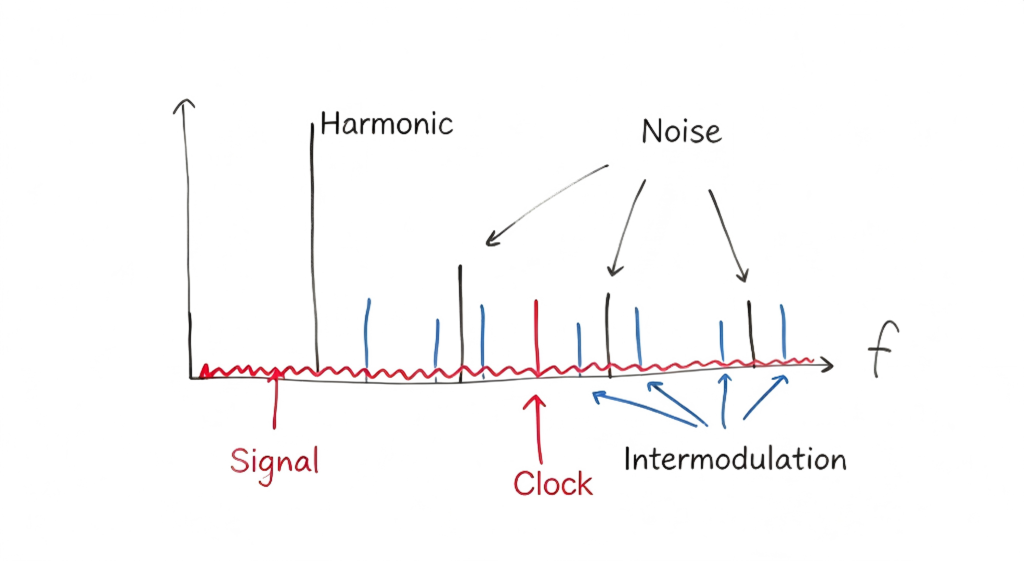
Noise is random and patternless—such as thermal noise, quantization noise, power supply noise, and clock jitter. Distortion, however, relates directly to the signal:
- Intermodulation: Products from clock leakage mixing with harmonics
- Harmonics: 2nd harmonic, 3rd harmonic
- Leakage: Clock leakage signals
An Everyday Analogy: Noise vs. Distortion in Photography
Let’s use photography as an analogy. When you take a photo in a low‑light environment, the camera’s ISO (sensitivity) is cranked up, and the image becomes covered in dense, random noise – that’s noise. When you take a photo in a bright environment, say directly into the sun, you get lens flare and ghosting; dust on the camera’s CMOS also creates dark spots. These regular false signals caused by external factors are distortion.


SNR vs. SINAD: Why SINAD Matters More in RF
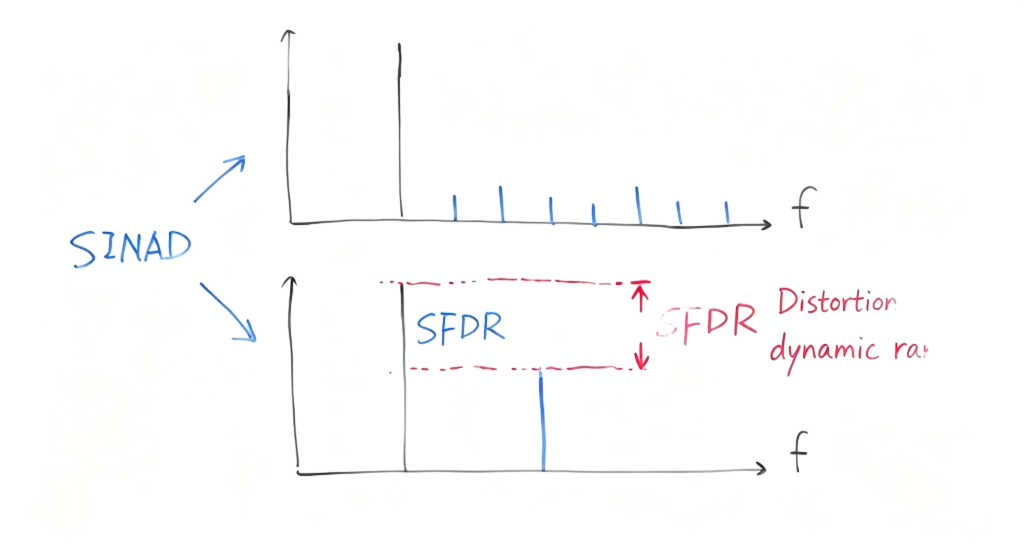
SNR (signal‑to‑noise ratio) is used to measure how much noise is in a system. SINAD (signal‑to‑noise‑and‑distortion ratio) measures the sum of noise and distortion. But in RF systems, SNR is often hard to calculate accurately because SNR should exclude distortion. The harmonics of the test signal are easy to remove, but it’s difficult to identify and remove all the distortion products caused by clock leakage and harmonic intermodulation.
That’s why, when the IEEE set the standard, they decided to ignore these intermodulation distortions altogether – as a result, the calculated noise power actually includes some distortion power as well.
ENOB and SINAD
(ENOB = (SINAD – 1.76)/6.02)
RF systems have a lot of intermodulation distortion, so the SNR metric is particularly imprecise and has limited reference value. SINAD is much better because it includes all noise and distortion. That’s why the effective number of bits (ENOB) of an ADC is calculated based on SINAD.
SFDR: The Most Critical Metric for Radar and EW Systems
Although SINAD reflects the overall level of noise and distortion in a system, the metric that can single‑handedly reject an RF system is SFDR (spurious‑free dynamic range). Imagine two systems with the same SINAD value – one may have many small spurious signals adding up, while the other has only one very large spurious signal.
That second case will cause trouble, because that large spurious signal can fool you. A false ghost on the radar screen could be mistaken for a real target, and you might end up wasting a multimillion‑dollar missile while also exposing your radar’s position. So the largest spurious signal is the most dangerous. SFDR measures the size of that spurious signal – any signal larger than that can be considered real.
A Worked Example: SNR, SINAD, and SFDR Calculation
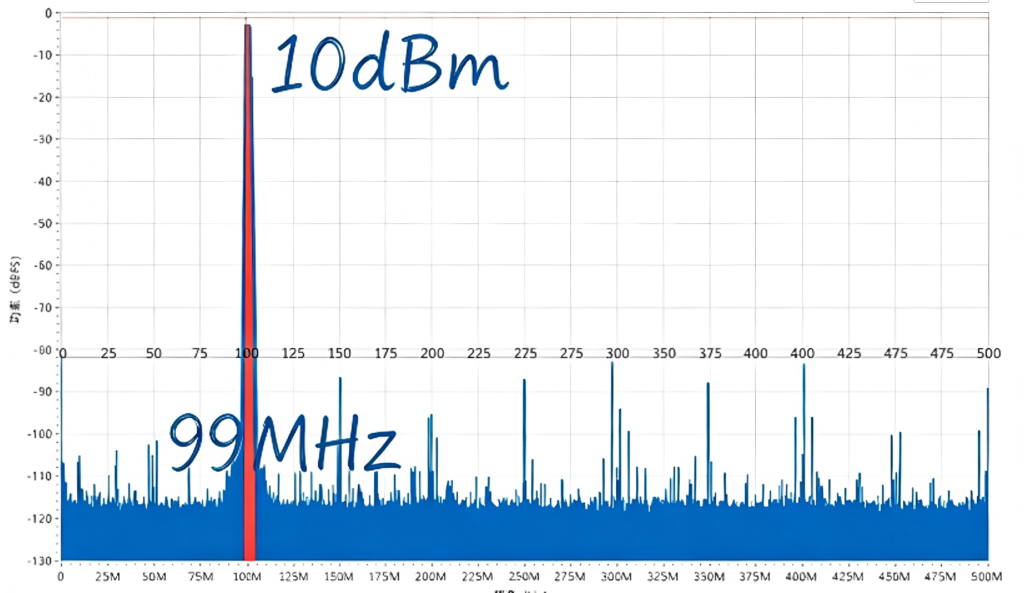
Now let’s work through an actual calculation together. Here we have an acquisition board with a sampling rate of 1 GHz and 16‑bit resolution. We apply a single tone at 99 MHz. Suppose the full‑scale power is exactly 10 dBm. We remove the DC component, the 99 MHz fundamental, and the integer multiples (198, 297, 396, 495 MHz). The total power of the remaining signals is -56.1 dBm, so the SNR is 66.1 dB.
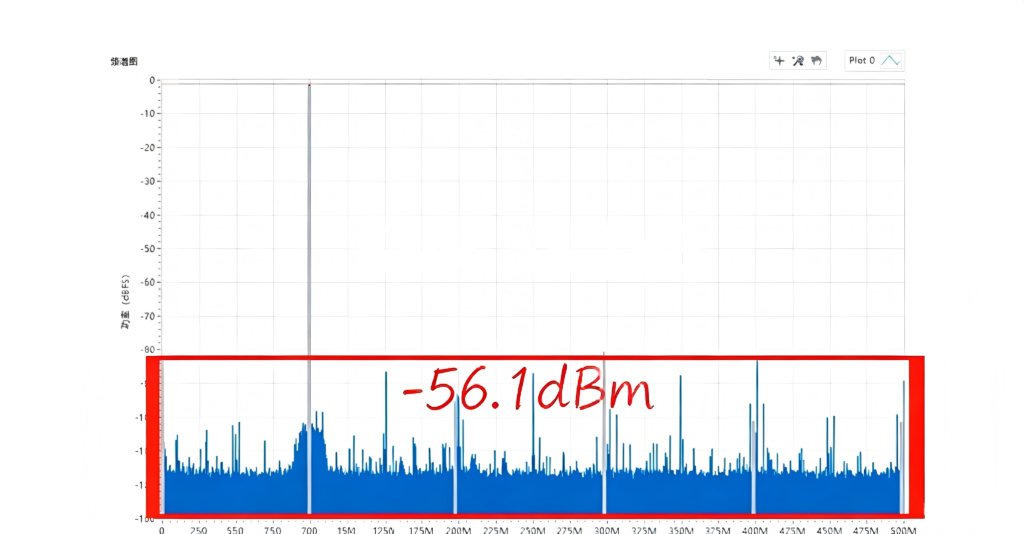
If we remove only DC and the 99 MHz input signal, the total power of the remaining signals is -55.9 dBm, so the SINAD is 65.9 dB.
If the largest spurious signal apart from the 99 MHz signal is -70.6 dBm, then the SFDR is 80.6 dBc. See? It becomes clear all at once.
Want to ensure your ultra-wideband RF signal record playback measurements are equally precise? Explore our calibration kits and RF accessories.