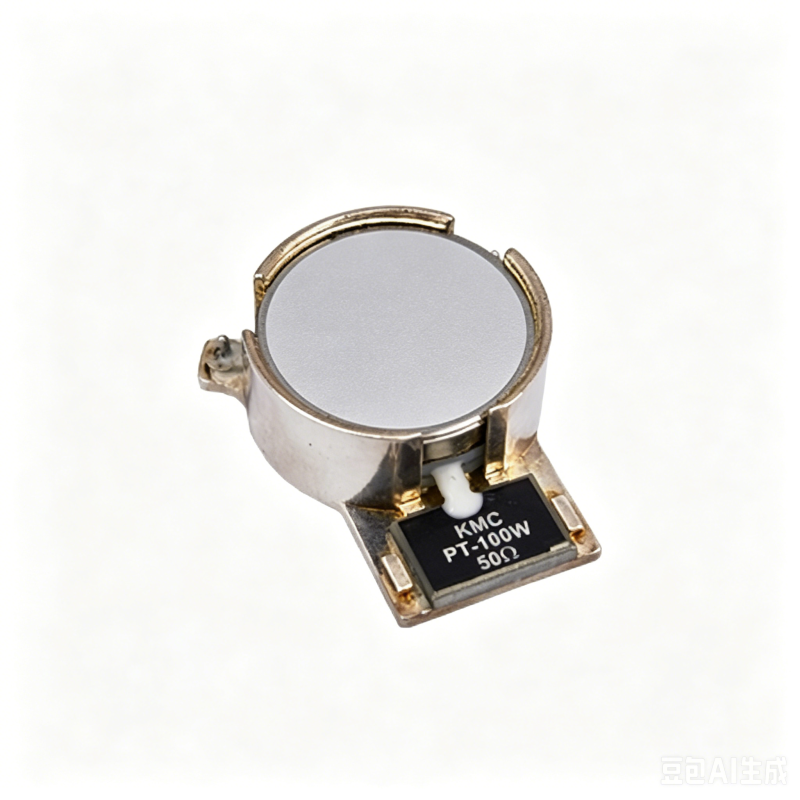
The surface mount isolator represents the ultimate miniaturization of non-reciprocal ferrite technology. Encapsulated in a robust SMT-compatible package, it delivers the same essential function — passing forward signals while blocking reverse reflections — in a footprint that occupies minimal board space, making it perfect for next-generation compact wireless devices.
Working Principle
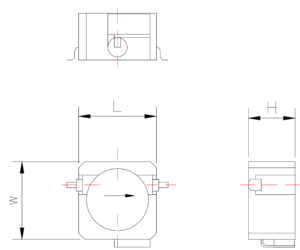
Internally, a micro Y-junction stripline with a magnetized ferrite disk and a thin-film integrated load forms the isolator. One port transitions from the Y-junction to the output, while another is terminated on-chip. The third port serves as the input. Forward transmission is low-loss; reverse signals are absorbed by the integrated load. The entire assembly is housed in a surface-mount package suitable for standard reflow soldering profiles.
Key Features
Tiny SMT Footprint: Sizes as small as 3 mm x 3 mm or 4 mm x 4 mm, ideal for ultra-compact PCBs.
Full SMT Reflow Compatibility: Withstands standard lead-free reflow temperatures and processes.
Reliable Ferrite Performance: Delivers isolation >15 dB and insertion loss <0.8 dB across designated bands (e.g., 2.4 GHz, 5 GHz, etc.).
Tape-and-Reel Packaging: Supports high-speed automated assembly for mass production.
Broad Application Range: Suited for smartphones, wearables, small cells, phased arrays, and any space-constrained RF system.
Specifications