No. 888 West Ring Lake Road II Lingang, Shanghai Pilot Free Trade Zone, China
Open Boundary Dual-Polarization Four-Ridged Horn Antenna
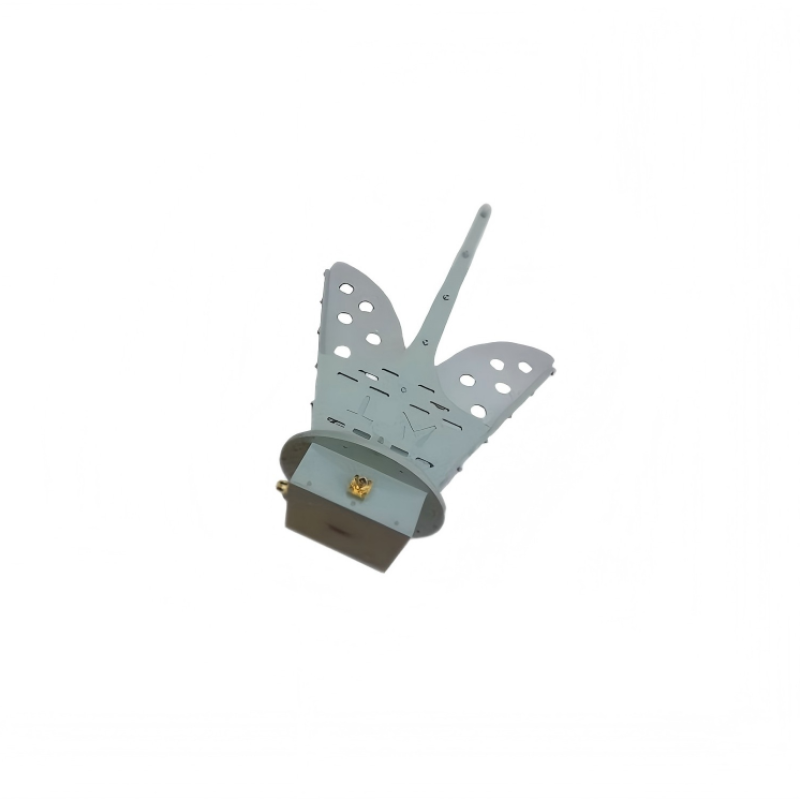
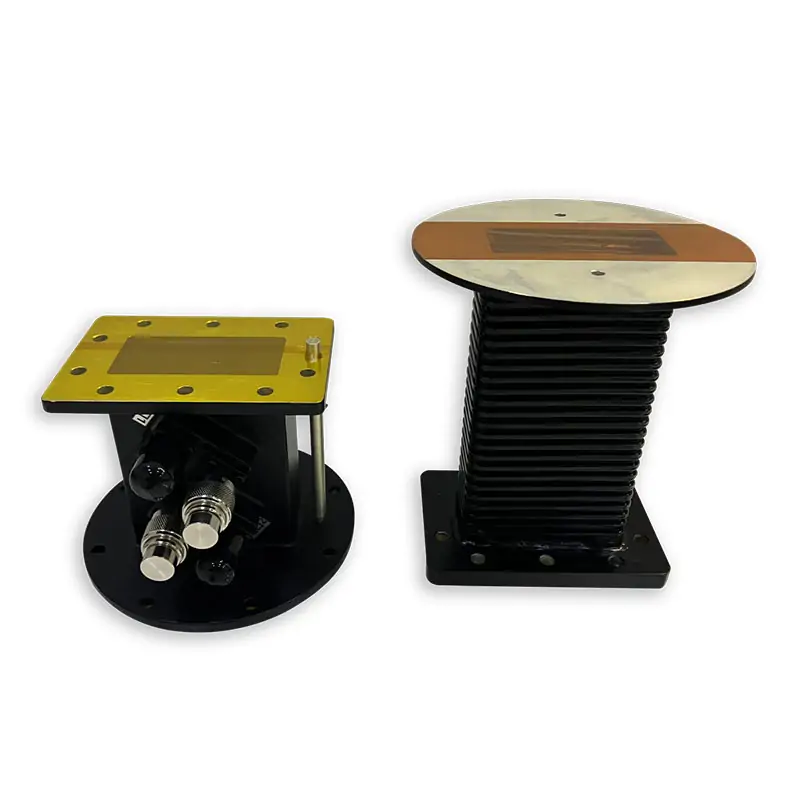
This novel antenna removes the enclosed sidewalls of conventional horn antennas, retaining only four tapered metal ridges and a feeding base to form a skeleton-style open structure.
In short, this novel antenna removes the enclosed sidewalls of conventional horn antennas, retaining only four tapered metal ridges and a feeding base to form a skeleton-style open structure. It integrates ultra-wideband, dual polarization, miniaturization and wide beamwidth in one design. Compared with traditional enclosed quad-ridged horns, it features wider bandwidth, smaller dimension, superior low-frequency performance and more stable phase center.
Definition
Open Boundary: No continuous metallic horn sidewalls. The structure is solely supported by four orthogonal tapered metal ridges and a feeding cavity/base with fully open surroundings. Electromagnetic waves radiate directly from the gaps between ridges.
Dual-Polarized Quad-Ridged Configuration: Four ridges are arranged in a cross orthogonal layout. Paired ridges are fed independently to excite horizontal and vertical (H/V) linear polarization and realize co-aperture radiation.
Essential Difference: Traditional quad-ridged horns adopt closed conical or pyramidal metallic sidewalls; the open-boundary design eliminates sidewalls and only reserves ridge frameworks, representing an advanced wall-less structural evolution.
Typical Structure (Rear to Front)
Dual-Feed Base: Equipped with orthogonal 50Ω SMA/2.92mm ports, built-in cross OMT and reflective cavity (similar to Vivaldi cavity structure). It extends low-frequency current paths and optimizes low-frequency impedance matching.
Quad-Ridged Skeleton Frame: Four upper, lower, left and right metal ridges are orthogonally fixed on the base, flaring in exponential or Bessel gradient without any sidewall connection.
Open Radiation Aperture: The ridge terminals form a square or circular open aperture with no metallic boundary around. Electromagnetic waves radiate freely. The aperture size is approximately 0.45λ at the lowest operating frequency, much more compact than conventional horn antennas.