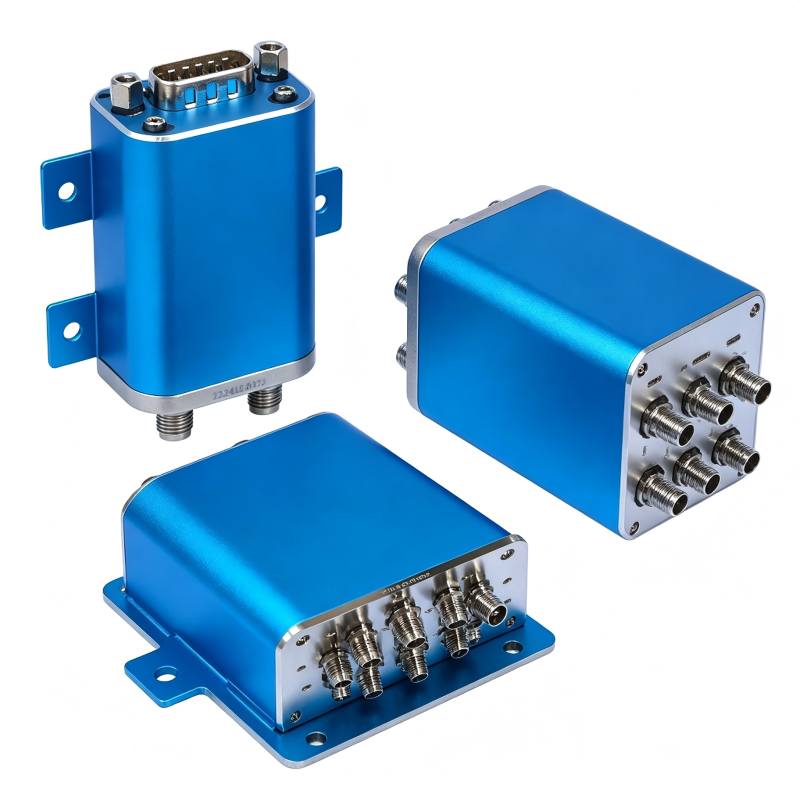
Coaxial switches route RF/microwave signals between different paths with wide bandwidth, low insertion loss, and high isolation. Available in electromechanical (latching/failsafe, DC–67 GHz) and solid-state (PIN/FET, ultra-fast switching) configurations, with common port arrangements like SPDT, SPnT, DPDT, and absorptive options for test, radar, and communication systems.
The coaxial switch is a passive/active device used for signal routing and switching in RF/microwave systems. Based on the coaxial transmission line structure, it enables gating or isolation of RF signals between different paths. Featuring wide bandwidth, low insertion loss, and high isolation, it is widely used in test & measurement, radar communication, satellite navigation, and similar applications.
Core Classifications and Principles
1. Electromechanical Coaxial Switch (Mainstream)
Principle: Electromagnetic actuation moves mechanical contacts (inner conductor/spring leaf) to connect or disconnect ports. Two types exist: latching (holds state after power removal) and failsafe (returns to default position when power is removed).
Characteristics: Wide frequency range (DC to 67 GHz), low insertion loss (≤0.3 dB), high isolation (≥60 dB), high power handling; but switching speed is slow (milliseconds) and has a limited mechanical life.
2. Solid-State Coaxial Switch (PIN/FET)
Principle: A PIN diode conducts when forward biased (low resistance) and blocks when reverse biased (high resistance). FETs control on/off states via gate voltage, with no mechanical movement.
Characteristics: High speed (microsecond to nanosecond range), long life, no wear; but insertion loss is higher, power handling is low, and isolation weakens at high frequencies.
3. Common Port Configurations
SPDT (Single Pole Double Throw): One input switches to two outputs; the most universal type.
SPnT (Single Pole n-Throw): One input selects among n outputs (e.g., SP4T, SP6T).
DPDT (Double Pole Double Throw): Two independent paths switch simultaneously, suitable for differential signals.
Absorptive: Unused ports are internally terminated with 50 Ω loads to suppress reflections and reduce VSWR.
Specifications