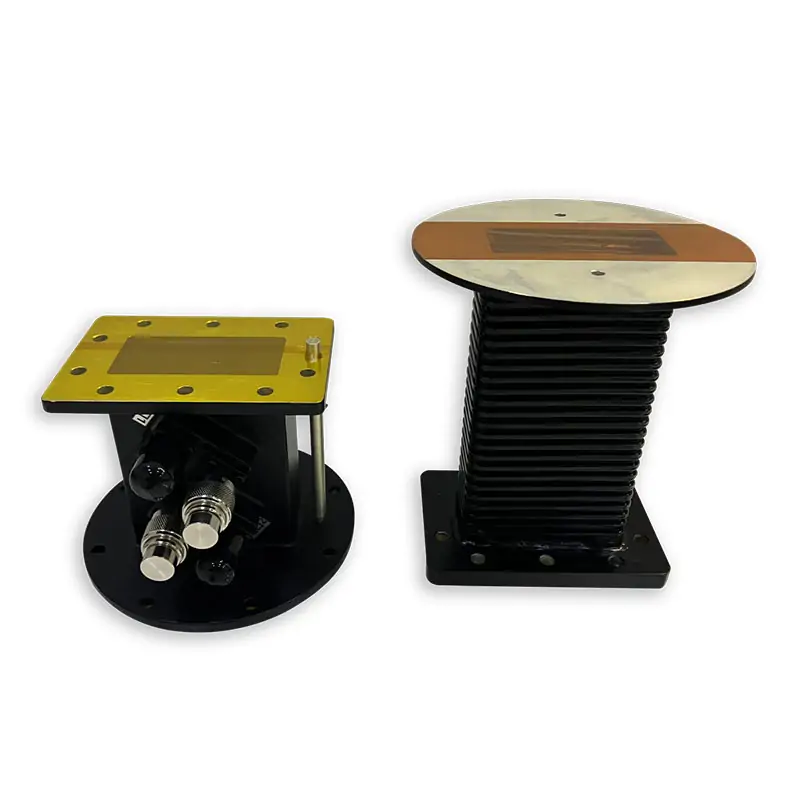
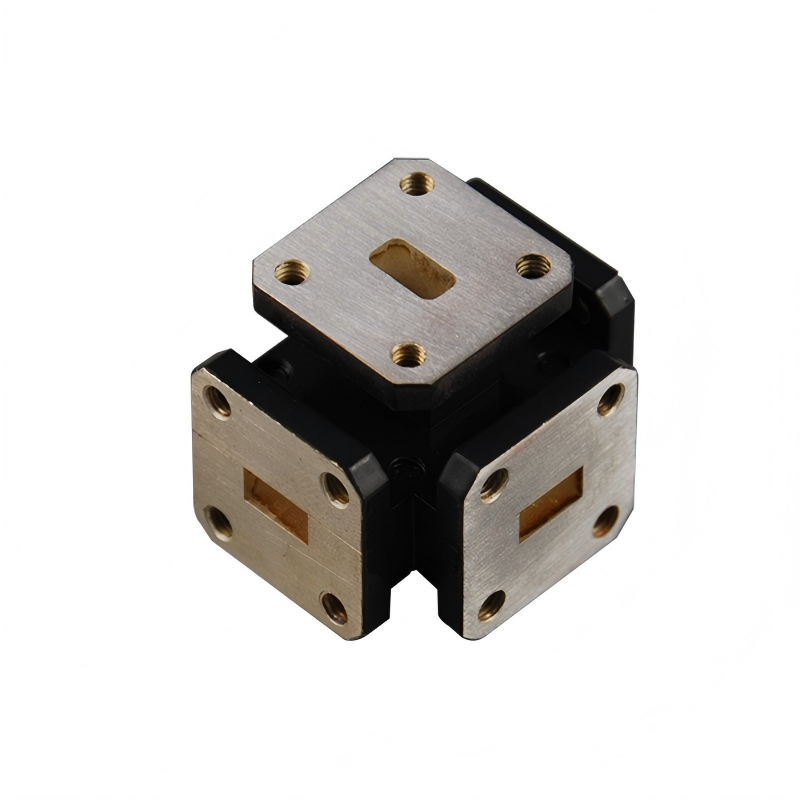
波导魔T.jpg

The Waveguide Magic Tee is a four-branch waveguide component combined with an E-plane tee and an H-plane tee. It features four fully matched ports and is classified as a 180-degree hybrid power divider.

Definition and Structure

Definition: The Waveguide Magic Tee is a four-branch waveguide component combined with an E-plane tee and an H-plane tee. It features four fully matched ports and is classified as a 180-degree hybrid power divider.
Structure: It is composed of three mutually perpendicular flanged sections of standard waveguide. Two branch arms are symmetrically arranged on the broad wall and narrow wall of the main T-section to form E-plane and H-plane connections respectively.

Working Principle

Power Division

The Magic Tee realizes power distribution based on odd-even symmetry of electromagnetic waves. Odd symmetric waves transmit equally with opposite phases in balanced arms, while even symmetric waves transmit equally in the same direction, achieving high port isolation and reasonable energy distribution.

Port Characteristics

  • E-plane Port (Difference Arm)

    It acts as a 180° out-of-phase port relative to two collinear ports. When a signal is injected from the E-plane port, equal-amplitude and anti-phase signals are output from the two side arms, with no energy coupled into the H-plane port.

  • H-plane Port (Sum Arm)

    It serves as an in-phase port for the two collinear ports. When excitation is applied to the H-plane port, signals are equally divided and output in phase through two side arms, while the E-plane port remains isolated.

  • Collinear Ports

    A signal entering one collinear arm will be equally coupled to the E-arm and H-arm without transmitting to the opposite collinear port. If two collinear ports are fed simultaneously, the E-arm outputs half of the vector difference of the two input signals, and the H-arm outputs half of the vector sum.
Supplementary Description of H-Plane Tee

The H-plane tee is a typical waveguide power divider, constructed by H-plane curved waveguide and straight waveguide.
  • Signals fed from the H-plane shunt port are equally divided in-phase between two through ports;
  • Signals injected from the E-plane series arm are split equally with 180° phase difference.
This characteristic originates from the odd-even electromagnetic field symmetry inside the waveguide: even-mode waves propagate in the same direction, and odd-mode waves propagate reversely, which guarantees effective port isolation and stable power splitting performance.

Specifications

Home
Products
News
Contact Us
Search